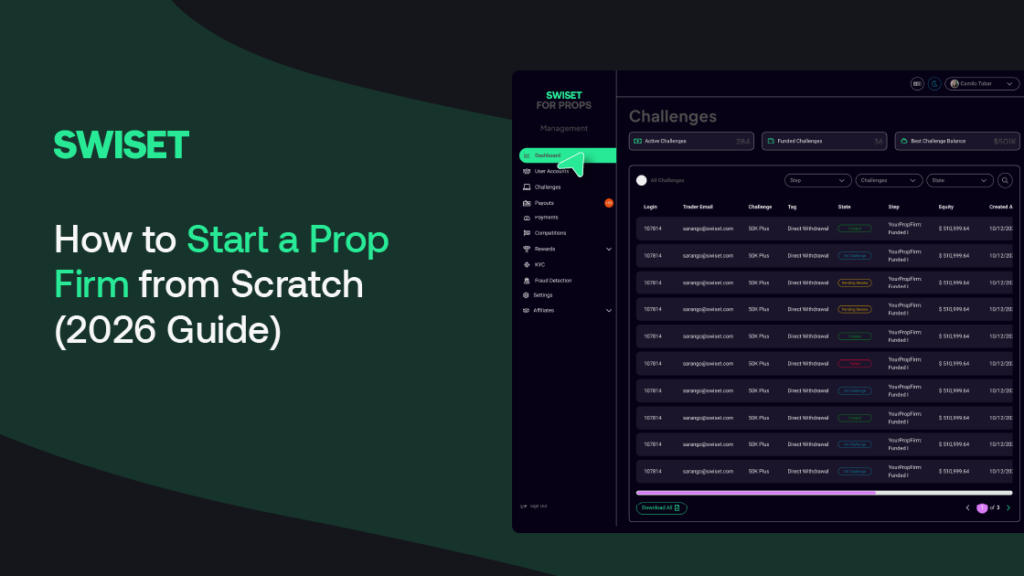
How to Start a Prop Firm from Scratch (2026 Guide)

trading competitions
trading tournament
white label
competitions software
technology for trading competitions
how to create trading competitions
how to do a trading tournament
demo trading competitions software
white label live trading tournament platform
poker a like trading competitions

Thinking About Starting a Prop Firm?

The proprietary trading industry has experienced explosive growth over the last few years.

What was once a niche business model has become a global market where traders can access funded accounts, firms can scale internationally, and technology makes it possible to serve thousands of users without building an enormous team.

As a result, many entrepreneurs, brokers, educators, trading communities, and fintech companies are now asking the same question:

How do you start a prop firm from scratch?

The reality is that launching a prop firm today is not simply about creating challenge rules and selling accounts.

Success depends on technology, risk management, trader experience, compliance processes, payments, automation, and scalability.

In this guide, you’ll learn everything you need to know about launching a prop firm from the ground up, including the infrastructure required to operate professionally and the common mistakes that cause new firms to fail.

What Is a Prop Firm?

A prop firm (proprietary trading firm) is a company that provides traders access to capital after they successfully complete a predefined evaluation process.

Instead of risking their own funds, traders prove their skills by meeting specific objectives such as:

  • Profit targets
  • Maximum drawdown limits
  • Daily loss limits
  • Consistency requirements
  • Risk management rules

Once approved, traders gain access to funded accounts and may receive a percentage of the profits they generate.

This model has become increasingly popular because it creates opportunities for traders while generating recurring revenue streams for firms.

Why Start a Prop Firm in 2026?

Several factors continue to drive growth in the prop trading industry:

Growing Demand for Funded Accounts

Many traders prefer accessing larger amounts of capital rather than risking their personal savings.

Global Reach

Modern prop firms can operate internationally, attracting traders from dozens or even hundreds of countries.

Recurring Revenue Opportunities

Revenue can come from:

  • Evaluation purchases
  • Challenge resets
  • Add-ons
  • Affiliate programs
  • Community initiatives
  • Educational products

Technology Is More Accessible

Years ago, building a prop firm required an expensive internal development team.

Today, specialized infrastructure providers make it possible to launch much faster and with significantly lower costs.

Step 1: Define Your Prop Firm Business Model

Before building anything, determine what type of prop firm you want to create.

Some common approaches include:

Traditional Evaluation Model

Traders complete one or multiple phases before becoming funded.

Examples:

  • One-step challenge
  • Two-step challenge
  • Three-step challenge

Instant Funding Model

Traders receive access immediately while following strict risk parameters.

Community-Based Prop Firm

Trading educators, influencers, and communities launch branded funding programs for their audiences.

Broker-Owned Prop Firm

Brokers use prop firms to improve acquisition, engagement, retention, and deposits.

The business model you choose will influence your technology requirements and operational structure.

Step 2: Create Your Challenge Rules

Challenge rules are the foundation of every prop firm.

Well-designed rules balance:

  • Trader attraction
  • Risk management
  • Profitability
  • Scalability

Popular challenge rules include:

Drawdown Rules

  • Static Drawdown
  • Dynamic (Trailing) Drawdown
  • End-of-Day Trailing Drawdown
  • Threshold-Based Drawdown

Daily Loss Rules

  • Fixed Daily Loss
  • Equity-Based Daily Loss
  • Balance-Based Daily Loss

Risk Management Rules

  • Maximum Exposure Per Trade
  • Maximum Position Size
  • Per-Trade Risk Limits

The more sophisticated your rules become, the more important it is to have a rules engine that validates them automatically.

Step 3: Build Your Technology Infrastructure

This is where many new prop firms encounter problems.

Launching a website is easy.

Operating a scalable prop firm is not.

A modern prop firm typically needs:

Commercial Website

Your website should include:

  • Pricing pages
  • Challenge information
  • FAQs
  • Checkout process
  • Affiliate information
  • Support resources

Trader Dashboard

Traders expect access to:

  • Challenge progress
  • Account credentials
  • Performance analytics
  • Rule tracking
  • Payout eligibility
  • Certificates
  • Leaderboards

Modern traders compare firms based on user experience, not only pricing.

Admin Dashboard

Your team needs tools to manage:

  • Accounts
  • Challenges
  • Payouts
  • Risk monitoring
  • Fraud detection
  • KYC processes
  • User management

Without centralized administration, scaling becomes extremely difficult.

Step 4: Integrate Trading Platforms

Your prop firm must connect to trading platforms where users will operate.

Common options include:

  • MetaTrader 4
  • MetaTrader 5
  • Other supported trading environments

The integration should automate:

  • Account creation
  • Credential delivery
  • Rule monitoring
  • Performance tracking
  • Funding status updates

Manual processes quickly become bottlenecks as your trader base grows. 

Step 5: Set Up Payments and Checkout

A seamless payment experience directly impacts conversions.

Most successful prop firms integrate:

  • Credit cards
  • Alternative payment methods
  • Regional payment solutions
  • Affiliate tracking

The checkout flow should automatically:

  1. Receive payment
  2. Create trader account
  3. Generate credentials
  4. Deliver welcome emails
  5. Grant dashboard access

Automation significantly reduces operational workload.

Step 6: Implement KYC and Compliance Processes

As your prop firm grows, verification becomes increasingly important.

KYC processes help:

  • Verify user identity
  • Reduce fraud
  • Improve trust
  • Strengthen operational integrity

Traders increasingly expect professional standards from funding firms.

Step 7: Build a Fraud Detection System

Fraud remains one of the biggest challenges in the industry.

Common risks include:

  • Account sharing
  • Multi-account abuse
  • Rule circumvention
  • Coordinated trading behavior

Successful firms use fraud detection tools to identify suspicious activity before it becomes a larger problem.

Step 8: Develop a Risk Management Framework

Risk management is not optional.

The most sustainable firms actively monitor:

  • Trader exposure
  • Book allocation
  • Performance consistency
  • Funding eligibility
  • Payout requests

A robust risk infrastructure allows firms to make informed decisions while protecting profitability.

Step 9: Create a Trader Acquisition Strategy

Technology alone will not attract traders.

You need a growth engine.

Popular acquisition channels include:

Affiliate Programs

Many successful prop firms generate significant growth through affiliates and introducing partners.

Trading Communities

Communities often become powerful acquisition channels due to built-in trust.

Content Marketing

Publishing educational content can drive long-term organic growth.

Paid Advertising

Targeted campaigns can accelerate customer acquisition when properly optimized.

Step 10: Focus on Retention, Not Just Acquisition

Many firms focus heavily on acquiring traders while neglecting engagement.

Retention strategies may include:

  • Trading competitions
  • Leaderboards
  • Performance recognition
  • Community challenges
  • Achievement systems
  • Educational content

The firms that create ongoing engagement often build stronger long-term businesses.

Common Mistakes When Launching a Prop Firm

Building Technology Internally Too Early

Many founders underestimate development costs and timelines.

Using Too Many Manual Processes

Manual account creation, payouts, and validations become difficult to scale.

Weak Fraud Controls

Fraud can significantly impact profitability if not addressed early.

Poor User Experience

Complex dashboards and confusing processes create unnecessary friction.

Ignoring Scalability

Infrastructure should support future growth from day one.

How Much Does It Cost to Start a Prop Firm?

The answer depends on your approach.

Typical costs may include:

  • Website development
  • Dashboard development
  • Trading platform integrations
  • Payment gateways
  • KYC providers
  • Fraud detection systems
  • Risk management infrastructure
  • Marketing

For firms building everything internally, costs can quickly become substantial.

This is one reason many founders choose specialized prop firm technology providers instead of assembling multiple disconnected solutions.

Why Many New Prop Firms Choose Swiset

Launching a prop firm involves much more than creating challenge rules.

You need an entire ecosystem capable of supporting traders, administrators, compliance processes, and future growth.

Swiset provides an end-to-end infrastructure for prop firms, including:

  • Professional commercial websites
  • Trader dashboards
  • Admin dashboards
  • Automated account creation
  • Challenge rule validation
  • Multi-platform support
  • Payout eligibility systems
  • KYC integrations
  • Fraud detection tools
  • Risk management modules
  • Affiliate systems
  • Leaderboards
  • Competitions
  • Payment gateway integrations
  • Multilingual environments

With experience supporting more than 50 launched prop firms, over 100,000 active accounts, and clients across more than 140 countries, Swiset helps firms reduce complexity and accelerate time to market.

Final Thoughts

Starting a prop firm from scratch is more accessible than ever before.

However, success depends on more than challenge pricing or marketing campaigns.

The firms that thrive are the ones that invest in:

  • Strong infrastructure
  • Automated operations
  • Risk management
  • Fraud prevention
  • Exceptional user experience
  • Long-term scalability

If you’re planning to launch a prop firm and want to avoid years of development, operational complexity, and fragmented tools, Swiset can help you launch faster with a proven end-to-end solution built specifically for the prop trading industry.

Ready to Launch Your Prop Firm?

Explore how Swiset helps entrepreneurs, brokers, educators, and trading communities build and scale modern prop firms.

Request a demo and discover how you can launch your prop firm faster with Swiset.

FAQs

Depending on your technology setup and operational requirements, a prop firm can take anywhere from a few weeks to several months to launch.

Not necessarily. Many firms use specialized technology providers to avoid the cost and complexity of building everything internally.

Most firms use combinations of profit targets, drawdown limits, daily loss limits, and consistency requirements.

Through specialized monitoring systems, behavioral analysis, account reviews, and automated fraud detection tools.

Yes. Many brokers are expanding into the prop firm space as a way to diversify revenue streams and improve trader engagement.

Related Posts