
How to choose a Tech Provider for your Prop Firm
And why prop firms switch technology providers.
The real reasons behind vendor lock-in, hidden fees, and structural limitations

- 6 min
- Manuela Palacio
Content
Executive summary
The prop firm industry has evolved rapidly over the last few years.
Funding models have diversified, risk management has become more sophisticated, and trader expectations have increased significantly.
However, one critical component has not evolved at the same pace: technology providers.
This article outlines the most common structural reasons why prop firms become dissatisfied with their current technology partner, why switching often feels unnecessarily difficult, and what modern prop firms should expect from their technology stack moving forward.
1. Technology built for control, not partnership
Many of the technology solutions currently used by prop firms were not originally designed to support long-term scalability or operational flexibility.
Instead, they rely on:
rigid contractual structures
limited customization
centralized roadmaps controlled entirely by the provider
This approach prioritizes provider control over client alignment, creating dependency rather than partnership.
Over time, this misalignment becomes a strategic limitation for prop firms.
2. Vendor lock-in presented as stability
“Stability” is frequently used as a selling point by legacy providers.
In practice, this stability is often enforced through:
-
long-term, inflexible contracts
-
unilateral termination clauses
-
exit penalties or operational barriers
-
limited negotiation power
As a result, many prop firms remain with providers they are no longer satisfied with, not because the technology delivers value, but because switching feels risky.
This is not true stability.
It is vendor lock-in.
3. Growth penalized through pricing models
Another recurring issue across the industry is pricing structures that penalize growth.
Common patterns include:
additional fees for new features
charges for reports, integrations, or modules
tiered access to innovation
As prop firms scale, their operational costs increase disproportionately, not due to infrastructure needs, but due to pricing design.
In this model, innovation becomes a variable cost rather than a shared objective.
4. UX/UI as an underestimated business risk
User experience is often treated as a secondary concern by technology providers.
However, for prop firms, UX/UI directly impacts:
trader onboarding
engagement and retention
brand perception
conversion efficiency
Outdated interfaces, complex flows, and low usability introduce friction that undermines growth efforts, often without immediate visibility in traditional KPIs.
UX is not a cosmetic layer.
It is a core operational and commercial driver.
5. Limited control over product roadmap
Prop firms operate in a fast-changing environment.
Regulatory shifts, new funding models, and evolving trader behavior require continuous adaptation.
Yet many providers:
deprioritize client feedback
delay feature requests
operate on roadmaps misaligned with prop firm needs
When a prop firm’s growth depends on decisions made externally, its ability to compete is fundamentally constrained.
6. Why switching providers feels unnecessarily complex
Despite widespread dissatisfaction, many firms delay switching providers due to perceived risks such as:
operational downtime
data migration complexity
rule replication challenges
internal disruption
These risks are often overstated, and sometimes structurally embedded, reinforcing dependency and slowing market evolution.
7. Swiset’s approach: a different operating model
At Swiset, we approached these industry challenges as product and partnership design problems, not marketing opportunities.
Our core principles are simple:
Contractual flexibility
No lock-in contracts.
Partnerships should be sustained by value, not enforced by legal constraints.
Inclusive innovation
Every feature we release is available to all clients.
No upsells. No hidden fees.
Adaptive technology
Our infrastructure is designed to evolve alongside each prop firm’s business model.
UX as a growth lever
User experience is treated as a first-class component of operational performance.
8. Rethinking migration as a strategic decision
If technology is truly aligned with prop firm needs, switching providers should not represent risk — it should represent progress.
Swiset’s migration process is designed to:
replicate existing logic and operational rules
minimize disruption
remove technical and operational friction
The goal is continuity, not experimentation.
Conclusion: what prop firms should evaluate
Choosing a technology provider is no longer a technical decision alone.
It is a strategic one.
Prop firms should critically assess whether their current provider:
enables or restricts growth
aligns incentives
evolves at the pace of the business
supports long-term competitiveness
When technology becomes a constraint, the cost is rarely immediate, but it is always cumulative.
About Swiset
Swiset builds technology for prop firms, brokers, and trading businesses that require flexibility, scalability, and operational clarity.
If you are evaluating a change in your technology stack, our team is open to a conversation.
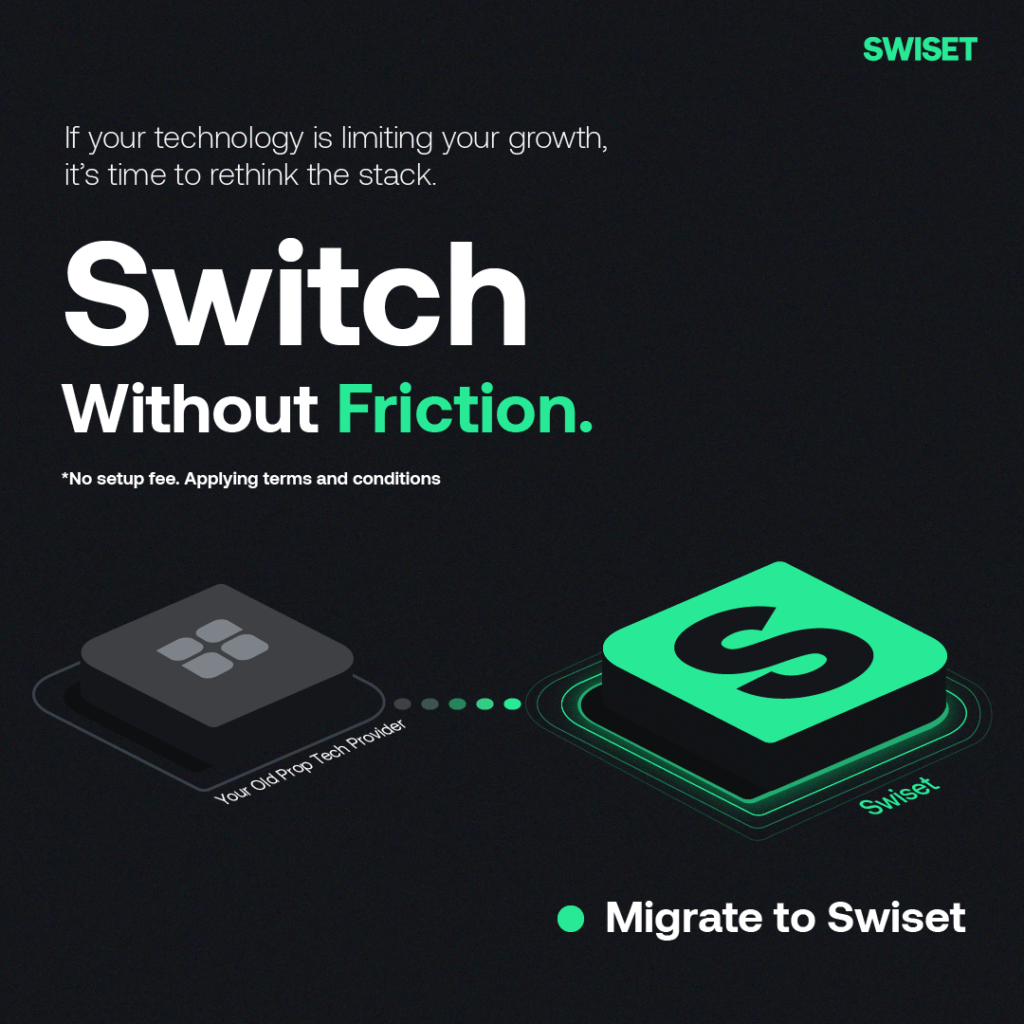
Explore Swiset Migration Program
The Swiset Migration Program is designed to help prop firms switch providers with minimal disruption, full operational continuity, and no lock-in contracts.